


Helpful Score: 5
Although dark, difficult subject, an engrossing read. Excellent characterizations. Enlightening and heartbreaking at same time.
Helpful Score: 5
What a good read ... Ondaatje, author of The English Patient, writes this about his homeland - Sri Lanka. Very moving.
Helpful Score: 3
Like The English Patient, by the same author, this novel is a very intense story of a young woman caught up in the middle of a war--this one in Sri Lanka in the 1980s and 90s. I found it very moving, but there are some intense descriptions of atrocities.
Helpful Score: 3
Ondaatje writes of the unimagineable without preaching and with enough restraint to permit his reader to imagine what it would be like to live through such times. Wonderful.
Helpful Score: 3
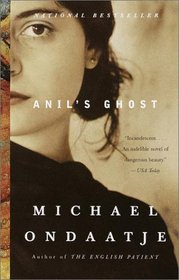
The cover says that this book is about Anil Tissera but I think that it's really about four people - Anil; Sarath, a fellow scientist; Sarath's brother, Gamini, a physician; and Ananda, an artist. The book focuses on how the conflict in Sri Lanka affects these four characters and probably, how Anil's values and beliefs affect the others both directly and indirectly. It's realistic, sad at times and stimulating, too. How do four people deal with such tragedy? Who chooses to challenge the powers in charge? Who wins? Who loses? It's an interesting journey to find the answers.
Helpful Score: 3
Takes place in Sri Lanka during modern times. A native woman returns after education in England and US. She is a forensic anthropologist with a quest to unlock the hidden past.

Helpful Score: 1
This fictional mystery brought out the modern day brutality and savagery of the Civil War/insurgencies in Sri Lanka. The overall plot tracing the work of a forensic anthropologist held my attention until the end, although the end was a little murky. I chose this book because I really enjoyed two other of the Ondaatje's works.
Helpful Score: 1
I should preface this review by saying I haven't finished the book yet, but I don't know if I'm going to. This book was VERY hard to get into for me. And it is very, very slow. It takes many pages for the smallest little thing to happen. Just couldn't get into it at all.
Helpful Score: 1
I picked this copy up in Antigua, Guatemala and brought it back to New Mexico, USA. Now I live in California. This book has had an interesting life so far! It was also a great read. It definately makes you think of life in a WORLD perspective. I definately recommend it as a thought provoking read.
Helpful Score: 1
This is a book about war and the devastation of war on the innocent. It makes an impact not so much in the descriptions of battle and devastation but in the dreamy quality to the story itself. Archeological pathologists find a body among others in a tomb which seems to be only five years dead. Their quest is to prove it had been reburied by government forces rather than by the various factions involved in Sri Lanka's civil war. With incredible use of language Ondaatje weaves the events from the past into the present and thus we are drawn into the events with the people involved. A beautiful book.
A forensic anthropologist in Sri Lanka, working for a human rights group to discover the source of the murders there... Exotic.
Helpful Score: 1
Ondaatje is an amazing writer. As in "the English Patient" his prose is poetic. Often after reading a phrase,
I'd stop, and say WOW, and then read it again to savor the sound, However, for the faint of heart, some of the political
atrocities were hard to handle,, But it's a way of life in many countries now. We don't accept it but we must acknowledge
it's existence.
I'd stop, and say WOW, and then read it again to savor the sound, However, for the faint of heart, some of the political
atrocities were hard to handle,, But it's a way of life in many countries now. We don't accept it but we must acknowledge
it's existence.

Another winner from Michael Ondaatje - Haunting, cultural, a favorite.

I did not care for this book-it seemed to drag on and on. But others really liked it:
In his Booker Prize-winning third novel, The English Patient, Michael Ondaatje explored the nature of love and betrayal in wartime. His fourth, Anil's Ghost, is also set during a war, but unlike in World War II, the enemy is difficult to identify in the bloody sectarian upheaval that ripped Sri Lanka apart in the 1980s and '90s. The protagonist, Anil Tissera, a native Sri Lankan, left her homeland at 18 and returns to it 15 years later only as part of an international human rights fact-finding mission. In the intervening years she has become a forensic anthropologist--a career that has landed her in the killing fields of Central America, digging up the victims of Guatemala's dirty war. Now she's come to Sri Lanka on a similar quest. But as she soon learns, there are fundamental differences between her previous assignment and this one:
The bodies turn up weekly now. The height of the terror was 'eighty-eight and 'eighty-nine, but of course it was going on long before that. The government was not the only one doing the killing.
In such a situation, it's difficult to know who to trust. Anil's colleague is one Sarath Diyasena, a Sri Lankan archaeologist whose political affiliations, if any, are murky. Together they uncover evidence of a government-sponsored murder in the shape of a skeleton they nickname Sailor.
In his Booker Prize-winning third novel, The English Patient, Michael Ondaatje explored the nature of love and betrayal in wartime. His fourth, Anil's Ghost, is also set during a war, but unlike in World War II, the enemy is difficult to identify in the bloody sectarian upheaval that ripped Sri Lanka apart in the 1980s and '90s. The protagonist, Anil Tissera, a native Sri Lankan, left her homeland at 18 and returns to it 15 years later only as part of an international human rights fact-finding mission. In the intervening years she has become a forensic anthropologist--a career that has landed her in the killing fields of Central America, digging up the victims of Guatemala's dirty war. Now she's come to Sri Lanka on a similar quest. But as she soon learns, there are fundamental differences between her previous assignment and this one:
The bodies turn up weekly now. The height of the terror was 'eighty-eight and 'eighty-nine, but of course it was going on long before that. The government was not the only one doing the killing.
In such a situation, it's difficult to know who to trust. Anil's colleague is one Sarath Diyasena, a Sri Lankan archaeologist whose political affiliations, if any, are murky. Together they uncover evidence of a government-sponsored murder in the shape of a skeleton they nickname Sailor.
This book is superbly written ~~ with Anil's past, present and future all interacting with the civil war happening in Sri Lanka. Anil leaves home at the age of 18 and returns years later to a different country than she had left and she tries to reconcile the two separate countries with one another only to leave in confusion.
Anil is an forensic anthropologist sent by an international human rights group to discover the source of the organized campaigns of murder engulfing Sri Lanka. She meets up with Sarath, her partner and his brother Gamini who is a surgeon who really sees the carnage of war. And in her search for truth, Anil embarks on a path of self-discovery along the way.
This is a beautifully written book ~~ very lyrical and lush. It isn't your typical fast-paced novel ~~ then again, life in the tropics aren't fast-paced except maybe in war. Ondaatje takes his time in developing the plot of the novel as he seems to want the reader to slow down and drink in the words he is putting forth about this island and its troubles. And you won't have trouble following along with Anil's story which is also interwined with other stories. Ondaatje keeps the same thread of idea with every one of the stories and ties them up neatly at the end.
I really enjoyed "The English Patient" and this book is just as good. Ondaatje is definitely a writer to keep an eye out for. He should be considered a classic writer ~~ he writes with a beautiful pen and brings the story with a subtle closure. His books aren't fast-paced as he wants you to think about what he is writing, especially when a person comes home and realizes that "you can't come home again." He explores the relationships between people, brothers, lovers and friends. You know where he's coming from because you've experienced it.
This is a definite keeper in anyone's library. Don't wait to pick this book up ~~ read it now and be entranced by Ondaatje's words of beauty and sorrow.
Anil is an forensic anthropologist sent by an international human rights group to discover the source of the organized campaigns of murder engulfing Sri Lanka. She meets up with Sarath, her partner and his brother Gamini who is a surgeon who really sees the carnage of war. And in her search for truth, Anil embarks on a path of self-discovery along the way.
This is a beautifully written book ~~ very lyrical and lush. It isn't your typical fast-paced novel ~~ then again, life in the tropics aren't fast-paced except maybe in war. Ondaatje takes his time in developing the plot of the novel as he seems to want the reader to slow down and drink in the words he is putting forth about this island and its troubles. And you won't have trouble following along with Anil's story which is also interwined with other stories. Ondaatje keeps the same thread of idea with every one of the stories and ties them up neatly at the end.
I really enjoyed "The English Patient" and this book is just as good. Ondaatje is definitely a writer to keep an eye out for. He should be considered a classic writer ~~ he writes with a beautiful pen and brings the story with a subtle closure. His books aren't fast-paced as he wants you to think about what he is writing, especially when a person comes home and realizes that "you can't come home again." He explores the relationships between people, brothers, lovers and friends. You know where he's coming from because you've experienced it.
This is a definite keeper in anyone's library. Don't wait to pick this book up ~~ read it now and be entranced by Ondaatje's words of beauty and sorrow.
Ondaatje's first novel since "The English Patient" is set in modern-day Sri Lanka, where Anil, a forensic anthropologist ventures to find the source of organized campaigns of murder on the island. Family identity and an unknown enemy feature prominently in the quest to unlock the hidden past. Unabridged.
A great novel by Ondaatje (also author of The English Patient).
By the author of "The English Patient"

Amazon.com
In his Booker Prize-winning third novel, The English Patient, Michael Ondaatje explored the nature of love and betrayal in wartime. His fourth, Anil's Ghost, is also set during a war, but unlike in World War II, the enemy is difficult to identify in the bloody sectarian upheaval that ripped Sri Lanka apart in the 1980s and '90s. The protagonist, Anil Tissera, a native Sri Lankan, left her homeland at 18 and returns to it 15 years later only as part of an international human rights fact-finding mission. In the intervening years she has become a forensic anthropologist--a career that has landed her in the killing fields of Central America, digging up the victims of Guatemala's dirty war. Now she's come to Sri Lanka on a similar quest. But as she soon learns, there are fundamental differences between her previous assignment and this one:
The bodies turn up weekly now. The height of the terror was 'eighty-eight and 'eighty-nine, but of course it was going on long before that. Every side was killing and hiding the evidence. Every side. This is an unofficial war, no one wants to alienate the foreign powers. So it's secret gangs and squads. Not like Central America. The government was not the only one doing the killing.
In such a situation, it's difficult to know who to trust. Anil's colleague is one Sarath Diyasena, a Sri Lankan archaeologist whose political affiliations, if any, are murky. Together they uncover evidence of a government-sponsored murder in the shape of a skeleton they nickname Sailor. But as Anil begins her investigation into the events surrounding Sailor's death, she finds herself caught in a web of politics, paranoia, and tragedy.
Like its predecessor, the novel explores that territory where the personal and the political intersect in the fulcrum of war. Its style, though, is more straightforward, less densely poetical. While many of Ondaatje's literary trademarks are present--frequent shifts in time, almost hallucinatory imagery, the gradual interweaving of characters' pasts with the present--the prose here is more accessible. This is not to say that the author has forgotten his poetic roots; subtle, evocative images abound. Consider, for example, this description of Anil at the end of the day, standing in a pool of water, "her toes among the white petals, her arms folded as she undressed the day, removing layers of events and incidents so they would no longer be within her." In Anil's Ghost Michael Ondaatje has crafted both a brutal examination of internecine warfare and an enduring meditation on identity, loyalty, and the unbreakable hold the past exerts over the present.
In his Booker Prize-winning third novel, The English Patient, Michael Ondaatje explored the nature of love and betrayal in wartime. His fourth, Anil's Ghost, is also set during a war, but unlike in World War II, the enemy is difficult to identify in the bloody sectarian upheaval that ripped Sri Lanka apart in the 1980s and '90s. The protagonist, Anil Tissera, a native Sri Lankan, left her homeland at 18 and returns to it 15 years later only as part of an international human rights fact-finding mission. In the intervening years she has become a forensic anthropologist--a career that has landed her in the killing fields of Central America, digging up the victims of Guatemala's dirty war. Now she's come to Sri Lanka on a similar quest. But as she soon learns, there are fundamental differences between her previous assignment and this one:
The bodies turn up weekly now. The height of the terror was 'eighty-eight and 'eighty-nine, but of course it was going on long before that. Every side was killing and hiding the evidence. Every side. This is an unofficial war, no one wants to alienate the foreign powers. So it's secret gangs and squads. Not like Central America. The government was not the only one doing the killing.
In such a situation, it's difficult to know who to trust. Anil's colleague is one Sarath Diyasena, a Sri Lankan archaeologist whose political affiliations, if any, are murky. Together they uncover evidence of a government-sponsored murder in the shape of a skeleton they nickname Sailor. But as Anil begins her investigation into the events surrounding Sailor's death, she finds herself caught in a web of politics, paranoia, and tragedy.
Like its predecessor, the novel explores that territory where the personal and the political intersect in the fulcrum of war. Its style, though, is more straightforward, less densely poetical. While many of Ondaatje's literary trademarks are present--frequent shifts in time, almost hallucinatory imagery, the gradual interweaving of characters' pasts with the present--the prose here is more accessible. This is not to say that the author has forgotten his poetic roots; subtle, evocative images abound. Consider, for example, this description of Anil at the end of the day, standing in a pool of water, "her toes among the white petals, her arms folded as she undressed the day, removing layers of events and incidents so they would no longer be within her." In Anil's Ghost Michael Ondaatje has crafted both a brutal examination of internecine warfare and an enduring meditation on identity, loyalty, and the unbreakable hold the past exerts over the present.
