


Helpful Score: 3
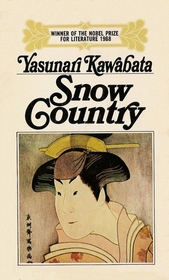
The Book Report: Married, bored (but I repeat myself) aesthete, philanderer, and flaneur Shimamura, an aficionado of Western ballet (although he's never seen one), takes a solo trip into Japan's Snow Country. While there in the wildest of boondocks Japan possesses, he meets Komako, probably the world's worst geisha, but apparently a fascinating contrast to all other women for Shimamura. They meet a total of three times in two years. Another woman, Yoko, hovers purposelessly around the narrative until, for no apparent reason, Komako and Shimamura have a fight over his feelings (?) for Yoko, who for some reason nursed Komako's not-quite-fiance Yukio while he died, despite the fact that Komako indentured herself to the (apparently quite unsuitable) career of geisha to pay for his death expenses.
Then a fire breaks out and Komako runs into the burning building and saves Yoko while Shimamura stands there and looks up at the sky. Fin.
No, seriously.
My Review: I spent the entire month I was reading this book, all 175pp of it, alternately claustrophobic and bemused. WTF, I kept thinking, why am I still at this rock-pile, trying to winkle out some small purpose to the narrative; then along would come a gem, eg: "It was a stern night landscape. The sound of the freezing of snow over the land seemed to roar deep into the earth. There was no moon. The stars, almost too many of them to be true, came forward so brightly that it was as if they were falling with the swiftness of the void." (p44, Vintage ed., trans. Seidensticker)
Oh wow, I thought, and plowed on. And on. And on. Every damn time Komako exhibits what today we'd call a bipolar break exacerbated by alcohol abuse, I'd find myself thinking, "This damned book is Come Back, Little Sheba directed by Kurosawa." Seriously. Shirley Booth did the same bloody role in that movie, only Burt Lancaster (whose role as her husband bewitched by a younger woman was pretty much exactly like Shimamura) is the one who drank.
I drank a good bit myself, trudging ever onward, marching off to war with the cross of Jesus going on before; okay, I'm a piss-poor Christian soldier, but you get the sense of futility I was experiencing. Then, it happened.
Pp154-155: "He had stayed so long that one might wonder whether he had forgotten his wife and children. He stayed not because he could not leave Komako nor because he did not want to. He had simply fallen into the habit of waiting for those frequent visits. And the more continuous the assault became, the more he began to wonder what was lacking in him, what kept him from living as completely...All of Komako came to him, but it seemed that nothing went out from him to her. He heard in his chest, like snow piling up, the sound of Komako, an echo beating against empty walls. And he knew he could not go on pampering himself forever."
So there *is* a point to this hike! And a profound one: The sudden awakening of human feeling in an otherwise dead heart. It was a payoff, and a major one. But did it have to be such a Bataan Death March of a journey to get here? And the stupid-ass last line of the book, which made me so bloody angry that I began raining curses on the lady whose idea it was our book circle read the book...! INFURIATINGLY SOPHOMORICALLY PORTENTOUS, I shrieked. The dog ran away from me. The same dog who, at an earlier moment in my tossing about of the book, expressed her opinion of it by fanging the corner. She calmed down after I did, but really...does one *want* to read this book? I won't do it again. But, on balance and after sleeping on it, I'm glad that I did.
Then a fire breaks out and Komako runs into the burning building and saves Yoko while Shimamura stands there and looks up at the sky. Fin.
No, seriously.
My Review: I spent the entire month I was reading this book, all 175pp of it, alternately claustrophobic and bemused. WTF, I kept thinking, why am I still at this rock-pile, trying to winkle out some small purpose to the narrative; then along would come a gem, eg: "It was a stern night landscape. The sound of the freezing of snow over the land seemed to roar deep into the earth. There was no moon. The stars, almost too many of them to be true, came forward so brightly that it was as if they were falling with the swiftness of the void." (p44, Vintage ed., trans. Seidensticker)
Oh wow, I thought, and plowed on. And on. And on. Every damn time Komako exhibits what today we'd call a bipolar break exacerbated by alcohol abuse, I'd find myself thinking, "This damned book is Come Back, Little Sheba directed by Kurosawa." Seriously. Shirley Booth did the same bloody role in that movie, only Burt Lancaster (whose role as her husband bewitched by a younger woman was pretty much exactly like Shimamura) is the one who drank.
I drank a good bit myself, trudging ever onward, marching off to war with the cross of Jesus going on before; okay, I'm a piss-poor Christian soldier, but you get the sense of futility I was experiencing. Then, it happened.
Pp154-155: "He had stayed so long that one might wonder whether he had forgotten his wife and children. He stayed not because he could not leave Komako nor because he did not want to. He had simply fallen into the habit of waiting for those frequent visits. And the more continuous the assault became, the more he began to wonder what was lacking in him, what kept him from living as completely...All of Komako came to him, but it seemed that nothing went out from him to her. He heard in his chest, like snow piling up, the sound of Komako, an echo beating against empty walls. And he knew he could not go on pampering himself forever."
So there *is* a point to this hike! And a profound one: The sudden awakening of human feeling in an otherwise dead heart. It was a payoff, and a major one. But did it have to be such a Bataan Death March of a journey to get here? And the stupid-ass last line of the book, which made me so bloody angry that I began raining curses on the lady whose idea it was our book circle read the book...! INFURIATINGLY SOPHOMORICALLY PORTENTOUS, I shrieked. The dog ran away from me. The same dog who, at an earlier moment in my tossing about of the book, expressed her opinion of it by fanging the corner. She calmed down after I did, but really...does one *want* to read this book? I won't do it again. But, on balance and after sleeping on it, I'm glad that I did.

