



 sevenspiders -
Helpful Score: 11
I found this book interesting but frustrating. The narrator was funny and "bumbling" but frankly I didn't find him all that sympathetic. And I thought there would be more about the role of literature in our lives, why books are still read a century later, what makes someone hate a book/author/anything enough to want to destroy it. It was a good premise, but the whole arson motif seemed like it was meant to grab your attention rather than to have any deeper siginificance to the book. But overall, it was a quick and interesting if ultimately unsatisfying read.
 Stephanie C. (crawford) reviewed An Arsonist's Guide to Writers' Homes in New England on + 59 more book reviews
Helpful Score: 7
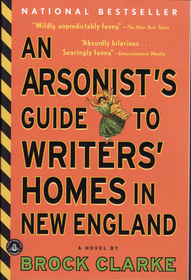
Reviewer Vanessa V. is *right* on the money- interesting but frustrating. This is a classic case of "don't judge a book by its cover"- from the title, description and even cover I thought this would be a darkly funny novel, which in fact in contains very, very little humor at all. We basically spend our entire time in the head of a character who doesn't learn most of the time, and the few times he does he doesn't apply the knowledge to anything. Paraphrasing many of his thoughts/actions through the books basically comes up with "Somewhere inside me I knew I should do this or anyone else in my shoes would do this, but I just couldn't." He's not only passive to an unbelievable degree- the way he constantly and knowingly puts himself in the wrong place at the wrong time is almost fetish-like.
There's a scene in the book where our "hero" stands up and recounts his story to a roomful of writers as a fictional story idea. When he's done, the writer on the platform tells him it doesn't work, that the character's dumb decisions that propel his narrative is simply "easy" and therefore not valid for good literature. I'm sure the author thought this was clever and ironic, but to me it just made the the author a glutton for bad choices as much as the creation on the page. I will say it is an original idea and wanting to know how it would all turn out kept me turning the pages, but for me this is not a keeper.
There's a scene in the book where our "hero" stands up and recounts his story to a roomful of writers as a fictional story idea. When he's done, the writer on the platform tells him it doesn't work, that the character's dumb decisions that propel his narrative is simply "easy" and therefore not valid for good literature. I'm sure the author thought this was clever and ironic, but to me it just made the the author a glutton for bad choices as much as the creation on the page. I will say it is an original idea and wanting to know how it would all turn out kept me turning the pages, but for me this is not a keeper.
Barbara R. (Crop4Fun) reviewed An Arsonist's Guide to Writers' Homes in New England on + 1217 more book reviews
Helpful Score: 7
In An Arsonist's Guide to Writers' Homes in New Englan, the quirkiest title for a book since Special Topics in Calamity Physics, Brock Clarke lights up the page with the chronicle of a man who, as a teenager, accidentally burned down the Emily Dickinson House in Amherst, Massachusetts, killing two people. ("It's probably enough to say that in the Massachusetts Mt. Rushmore of big gruesome tragedy, there are the Kennedys, and Lizzie Borden and her ax, and the burning witches at Salem, and then there's me.") After serving ten years in prison for the crime, Sam Pulsifer moves on with his life, but the emergence of a copycat who's turning New England's literary landmarks to ash puts Sam back in the spotlight and on a quest for the truth. Comparisons to The World According to Garp and A Confederacy of Dunces may be bold, but this heartfelt, funny, and highly entertaining tale promises to be Brock Clarke's breakout book for certain.
Carroll H. (Seahorse) reviewed An Arsonist's Guide to Writers' Homes in New England on + 30 more book reviews
Helpful Score: 2
The title promises much more than it is.
I really did not enjoy this book. I reached the end and went "that's it?" It didn't even work as a narrative of failure.
Each time it would go towards a promise of humor, it would back off. Each time it went towards a promise of pathos, it failed. The characters the author seemed to feel most clever were really quite bland.
There were a few nice descriptions of New England, old and new, but I think this would have made a much better short story than a novel. A man gets repeatedly blamed for something he didn't intentionally do until he finally takes the blame for it even though he clearly didn't do it.
Yeah, I just don't get it.
I really did not enjoy this book. I reached the end and went "that's it?" It didn't even work as a narrative of failure.
Each time it would go towards a promise of humor, it would back off. Each time it went towards a promise of pathos, it failed. The characters the author seemed to feel most clever were really quite bland.
There were a few nice descriptions of New England, old and new, but I think this would have made a much better short story than a novel. A man gets repeatedly blamed for something he didn't intentionally do until he finally takes the blame for it even though he clearly didn't do it.
Yeah, I just don't get it.
 Jeanne D. (jeepers) reviewed An Arsonist's Guide to Writers' Homes in New England on + 35 more book reviews
Helpful Score: 2
I emerged at the end of this strange, confusing, narrative sad and frustrated about "the human condition". I really enjoyed the frequent personification of, say, weather elements or other inanimate objects that gave the sense that everything has emotions or feelings. This tool was used throughout the novel by Clarke in a most effective and humorous way to convey's Sam's perceptions about his experiences. This bazaar tale of one man's profound ability (or disability) to always make the wrong choices in any given situation clarifies that we really do create our own life and circumstances. By the end of the book and after reading the Q & A and discussion sections of the book, I felt that Brock Clarke was poking fun at me for even finishing the book. Of course, the other joke on the reader is, if one reads to the conclusion, is the hope that one holds that the ending will be a good one and not the sad, twisted, disappointing, dishonest ending that is finally reached. I really liked Sam Pulsifer in the way on likes the runt of a litter and really hoped for better for him. That he ended up in worse shape at the end than the beginning without learning much along the way was frustrating. One hopes is that he is simply a harmless oaf who hurt no one but himself. The irony is that in his career, he "invented" many of the items of plastic junk that will possibly be the eventual downfall of our earth's environment and humankind itself. So it seems, he wasn't so much of a harmless oaf after all, but a very lethal one, by "accident". Kind of like the human race itself.
