



Helpful Score: 9
Be forewarned: this is not a book that you will finish in one night or two. That, however, is part of the books charm, because as you read the 616 oversized pages of jam-packed text you will not want it to end.. I certainly did not. Indeed, I was captivated by The Last Ship in a fashion that few books have ever been able to do. I began to think of the characters as real people, and I actually found myself at times having to reassure myself that this is, after all, just a book. Just a story.
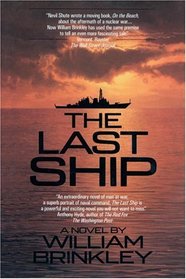
In part, I suspect, this is due to the subject matter. The Last Ship is the story of the U.S.S. Nathan James , a state-of-the-art navy destroyer, and home to some of the last survivors of an all-out nuclear war between the United States and the Soviet Union. Mainly, however, the reader is drawn in by the authors writing style. Brinkley doesnt just captivate his readers; he has a sort of power over them with his painstaking attention to detail, laborious prose, and exceptional command of the English language that few authors, at least in my experience, can equal.
The Last Ship follows the experiences of the Nathan James through a nuclear war that, through a quirk of fate, leaves her unscathed. The story is told in the first person through the eyes of her captain as he slowly realizes that the unthinkable has occurred, and the human race for all intents and purposes has destroyed itself. We never find out how the war started or why it was fought. These are unimportant, the author seems to think. Hes right, of course. Is there really any petty concern of mankind that can justify the slaughter of billions?
As the Nathan James cruises down the coasts of Europe, Africa, and Asia they are horrified at the destruction. Survivors, if they can be called such, gather on the beaches in hopes that help will arrive. Help that can never come. Brinkley describes in detail the terrifying effects of radiation poisoning, and at times these passages are difficult to read. This is not a book for the squeamish. There is also occasional explicit sexual content that may offend some as well.
Seeing the radiations effects firsthand, the crew of the Nathan James soon realizes they can never go home, and with a grim determination the captain realizes that his crew may be the last best hope for humanity to start again.
And so they begin the search for a habitable island in the Pacific where they can construct a new community with the ships complement of men and women (the former outnumbering the latter by roughly six to one). But there will be trials and tribulations along the way. A senior ships officer and a sizeable portion of the crew desperately want to return home to their loved ones despite the fact that America has been decimated and is now an uninhabitable radioactive wasteland. And an accommodation must be reached with the only group of survivors the Nathan James encounters: a Russian nuclear missile submarine.
Can humanity start over? Will the crew of the Nathan James be able to re-establish a shattered civilization? Can the American and Russian survivors overcome their mutual suspicions and learn to work together? The answers to these questions lie within the covers of The Last Ship, but dont expect things to go smoothly, and be prepared for more unexpected twists and turns than you can imagine along the way.
With a fascinating plot, highly intriguing characters and an all too possible (at the time the book was written) scenario, The Last Ship is one of the best reads I have come across in years. More than that, however, the book carries a very important message: a nuclear war simply cannot be won. The author takes great pains to portray in vivid detail the effects of the war exactly to hammer this point across.
In many respects, The Last Ship is a period piece and a product of its times. Published in 1988 just before the end of the Cold War, The Last Ship may seem outdated with the fall of the Soviet Union. Nothing could be further from the truth, however. For the threat of nuclear war may certainly rear its head again in the future. Those who contemplate it could be winnable (as some in the Reagan administration did in the eighties) need only to read this book to be convinced otherwise.
In sum, The Last Ship works, and works well. The story matter alone is enough to prove the novels value over time. But the authors luxuriant writing is what puts The Last Ship over the top. Obviously, the man is himself an avid reader of books, something that has made him an exceptional author. In proof of this, Ill let Brinkley himself have the last word on The Last Ship with one of my favorite passages, told by the captain himself.
"I have often wondered how anyone who does not read, by which I mean daily, having some book going all the time, can make it through life. Indeed if I were required to make a sharp division in the very nature of people, I would be tempted to make it there: readers and non-readers of books. ..It is astonishing how the presence or absence of this habit so consistently characterizes an individual in other respects; it is as though it were a kind of barometer of temperament, of personality, even of character. "
In part, I suspect, this is due to the subject matter. The Last Ship is the story of the U.S.S. Nathan James , a state-of-the-art navy destroyer, and home to some of the last survivors of an all-out nuclear war between the United States and the Soviet Union. Mainly, however, the reader is drawn in by the authors writing style. Brinkley doesnt just captivate his readers; he has a sort of power over them with his painstaking attention to detail, laborious prose, and exceptional command of the English language that few authors, at least in my experience, can equal.
The Last Ship follows the experiences of the Nathan James through a nuclear war that, through a quirk of fate, leaves her unscathed. The story is told in the first person through the eyes of her captain as he slowly realizes that the unthinkable has occurred, and the human race for all intents and purposes has destroyed itself. We never find out how the war started or why it was fought. These are unimportant, the author seems to think. Hes right, of course. Is there really any petty concern of mankind that can justify the slaughter of billions?
As the Nathan James cruises down the coasts of Europe, Africa, and Asia they are horrified at the destruction. Survivors, if they can be called such, gather on the beaches in hopes that help will arrive. Help that can never come. Brinkley describes in detail the terrifying effects of radiation poisoning, and at times these passages are difficult to read. This is not a book for the squeamish. There is also occasional explicit sexual content that may offend some as well.
Seeing the radiations effects firsthand, the crew of the Nathan James soon realizes they can never go home, and with a grim determination the captain realizes that his crew may be the last best hope for humanity to start again.
And so they begin the search for a habitable island in the Pacific where they can construct a new community with the ships complement of men and women (the former outnumbering the latter by roughly six to one). But there will be trials and tribulations along the way. A senior ships officer and a sizeable portion of the crew desperately want to return home to their loved ones despite the fact that America has been decimated and is now an uninhabitable radioactive wasteland. And an accommodation must be reached with the only group of survivors the Nathan James encounters: a Russian nuclear missile submarine.
Can humanity start over? Will the crew of the Nathan James be able to re-establish a shattered civilization? Can the American and Russian survivors overcome their mutual suspicions and learn to work together? The answers to these questions lie within the covers of The Last Ship, but dont expect things to go smoothly, and be prepared for more unexpected twists and turns than you can imagine along the way.
With a fascinating plot, highly intriguing characters and an all too possible (at the time the book was written) scenario, The Last Ship is one of the best reads I have come across in years. More than that, however, the book carries a very important message: a nuclear war simply cannot be won. The author takes great pains to portray in vivid detail the effects of the war exactly to hammer this point across.
In many respects, The Last Ship is a period piece and a product of its times. Published in 1988 just before the end of the Cold War, The Last Ship may seem outdated with the fall of the Soviet Union. Nothing could be further from the truth, however. For the threat of nuclear war may certainly rear its head again in the future. Those who contemplate it could be winnable (as some in the Reagan administration did in the eighties) need only to read this book to be convinced otherwise.
In sum, The Last Ship works, and works well. The story matter alone is enough to prove the novels value over time. But the authors luxuriant writing is what puts The Last Ship over the top. Obviously, the man is himself an avid reader of books, something that has made him an exceptional author. In proof of this, Ill let Brinkley himself have the last word on The Last Ship with one of my favorite passages, told by the captain himself.
"I have often wondered how anyone who does not read, by which I mean daily, having some book going all the time, can make it through life. Indeed if I were required to make a sharp division in the very nature of people, I would be tempted to make it there: readers and non-readers of books. ..It is astonishing how the presence or absence of this habit so consistently characterizes an individual in other respects; it is as though it were a kind of barometer of temperament, of personality, even of character. "

Helpful Score: 7
This is a very realistically told story of what could happen in the event a nuclear holocaust begins. It covers the events and the reality that they 'can't go home' because home is probably not there.
From conserving their stores, to how to begin life again in a new world, this story tells the hardships, joys, and trials experienced by one crew of a U.S. Navy destroyer that is truly "The Last Ship" on the waters of earth and how they try to survive.
I keep this book on my shelf to read over and over.
From conserving their stores, to how to begin life again in a new world, this story tells the hardships, joys, and trials experienced by one crew of a U.S. Navy destroyer that is truly "The Last Ship" on the waters of earth and how they try to survive.
I keep this book on my shelf to read over and over.

Helpful Score: 5
Let me start off by saying that I'm a big fan of post-apocalyptic books... but this one was hard to get into. The narrator is a very deep thinker with a propensity to ramble up to his final thoughts in a very convoluted, twisty manner. I found myself skimming many a single sentence paragraph looking for that final concrete idea the narrator was aiming for. I just couldn't get into his thought process and I've always figured myself as a rambling thinker/writer.
Perhaps it's because I'm a woman and the entire book is presented from a distinctly male voice - never delving into what the women are thinking - only wondering at and trying to read voice and mannerisms. To be honest, I skipped the entire middle of the book and don't feel like I missed out on much. The book starts off with the boat finding an island they can establish themselves on... just when it was getting interesting (how were they going to handle the fact that there were only 23 women and 100 something men...) the author decides to go into everything that led up to the war and what the ship went through to get to the island. By that point, I could have cared less and only wanted to know how they were going to handle the continuance of the race issue. So as I said, I read Book I: The Island and then skipped to Book VI: The Last Women.
All in all it was an okay read, but not a book I have to add to my collection to re-read (which is how I judge a great book)
Perhaps it's because I'm a woman and the entire book is presented from a distinctly male voice - never delving into what the women are thinking - only wondering at and trying to read voice and mannerisms. To be honest, I skipped the entire middle of the book and don't feel like I missed out on much. The book starts off with the boat finding an island they can establish themselves on... just when it was getting interesting (how were they going to handle the fact that there were only 23 women and 100 something men...) the author decides to go into everything that led up to the war and what the ship went through to get to the island. By that point, I could have cared less and only wanted to know how they were going to handle the continuance of the race issue. So as I said, I read Book I: The Island and then skipped to Book VI: The Last Women.
All in all it was an okay read, but not a book I have to add to my collection to re-read (which is how I judge a great book)

Helpful Score: 3
This book is at the top of my list in the genre of apocalyptic, and post apocalyptic, literature. I've read it twice, once at 27 and again at 57. The attention to characterization, plots and subplots, and every detail is amazing; it must have taken Mr. Brinkley at least five years (more like ten) to write this novel (I wrote a novel, took me three years and six drafts); he obviously poured a great deal of himself, or his ideal for himself, into the main character (by whom I was totally captivated). I can't recommend it highly enough.
Helpful Score: 1
This is an excellant read. The aftermath of nuclear stupidity is all too realistic. The survival of the few remaining individuals is well done by Brinkley.
