

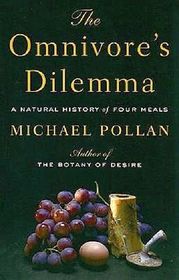


Anita W. reviewed The Omnivore's Dilemma : A Natural History of Four Meals on + 27 more book reviews
Helpful Score: 11
This is a book everyone should read. Eating is nutritional, is political, is global and we should never be ignorant about how we nourish our bodies. Pollan has provided a great assessment of modern eating.
 Elizabeth R. (esjro) -
Helpful Score: 10
This is a fascinating account of the origins of three types of meals - a fast food meal, an organic meal, and one composed of foods hunted and gathered by the author. This book could almost be seen as a sequel to Fast Food Nation: it is similar in format and both books are very readable. However, after reading this book you will feel guilty not only about eating Chicken McNuggets (who really believed that spongy white filling was chicken anyway?) but also about buying organic South American asparagus from Whole Foods and eggs from supposedly free range chickens at Safeway.
Unfortunately, not all of us have the luxury of being a published author, so that we can forage for morels, hunt wild boar, and capture yeast from the air around our neighborhoods in order to spend multiple days preparing slow food meals for our friends. Indeed, this type of elitism and the fact that foods obtained from sustainable farming sources are not affordable to many may turn some readers off to this book. That is unfortunate, because I don't think the author intends to imply that people are good or bad for eating a certain way - in my opinion, this book is more a call to THINK about what you eat, and make choices that you are comfortable with when you can.
Even if all of us only occasionally bought locally grown products from sustainable farms it would make a big difference... and I think that is what the author is trying to say. Make whatever choices you like, but at least make them informed choices.
Unfortunately, not all of us have the luxury of being a published author, so that we can forage for morels, hunt wild boar, and capture yeast from the air around our neighborhoods in order to spend multiple days preparing slow food meals for our friends. Indeed, this type of elitism and the fact that foods obtained from sustainable farming sources are not affordable to many may turn some readers off to this book. That is unfortunate, because I don't think the author intends to imply that people are good or bad for eating a certain way - in my opinion, this book is more a call to THINK about what you eat, and make choices that you are comfortable with when you can.
Even if all of us only occasionally bought locally grown products from sustainable farms it would make a big difference... and I think that is what the author is trying to say. Make whatever choices you like, but at least make them informed choices.
Helen G. (newgoddess) reviewed The Omnivore's Dilemma : A Natural History of Four Meals on + 2 more book reviews
Helpful Score: 9
A book that will make you rethink about how, where, why, when, and what you are eating. If you're curious about where your food comes from, the connection of our food to place and our lives; then you must read "The Omnivore's Dilemma". It will change your thought about how we, as Americans, feed ourselves.
 Jeanette R. (thebeakeeper) reviewed The Omnivore's Dilemma : A Natural History of Four Meals on + 167 more book reviews
Helpful Score: 8
omg. i had such a hard time getting through this. its interesting, but it read like a textbook. i kept debating just putting it down and moving on, but i forced myself to get through it, and am glad i did.
the book is split into three parts- or three meals. the first part is about how corn is in pretty much everything we eat. it talks about the price of corn- in terms of farming, gasoline and animals. the authors meal to represent this was fast food. gross.
the second part is about grass and the role grass plays in our meals. theres a lot of debates on what organic really is and the author lives on a fram for a week, where his meal is completely provided for by the farm.
the third part was my favorite. it was about huntering and gathering. everything the author ate had to come from something he hunted, gathered, forged. he included debates on vegetarianism and veganism, killing animals for food versus pleaseure, etc.
id recommend it to someone whos interested in the topic. its not a quick exciting read, but has a lot of great information. there were pages i skipped over because it got too technical, but i did come away from it better educated. and weve started buying from local farmers (or so they say!)
the book is split into three parts- or three meals. the first part is about how corn is in pretty much everything we eat. it talks about the price of corn- in terms of farming, gasoline and animals. the authors meal to represent this was fast food. gross.
the second part is about grass and the role grass plays in our meals. theres a lot of debates on what organic really is and the author lives on a fram for a week, where his meal is completely provided for by the farm.
the third part was my favorite. it was about huntering and gathering. everything the author ate had to come from something he hunted, gathered, forged. he included debates on vegetarianism and veganism, killing animals for food versus pleaseure, etc.
id recommend it to someone whos interested in the topic. its not a quick exciting read, but has a lot of great information. there were pages i skipped over because it got too technical, but i did come away from it better educated. and weve started buying from local farmers (or so they say!)
Helpful Score: 6
A brilliant and important book, which despite its weightiness, is very readable - Pollan as narrator is open, likeable, and never condescending. Every American ought to read this book...it's the first step toward reform of the fast-failing agricultural system in this country.


