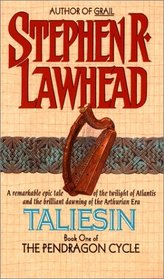
I wish I had read the reviews before reading this book. This book (and I assume the rest of the series) should be under the genre 'Christian Fantasy'. This is a story of the birth of Merlin and it strays so far from both the legend of King Arthur and the 'true' historical account that it left me wondering why the author didn't just tell a fictional story about his own characters and leave Arthur out of it. The constant religious preaching aside, the author managed to take what is supposed to be a magical story and made it boring.
Taliesin, book one in The Pendragon Cycle, is Stephen Lawhead's interpretation of the Merlin legend. It tells two simultaneous stories, which join about two-thirds of the way into the book. The first is about the life of the young Princess Charis (pronounced Ka-ris) and the fall of the legendary city, Atlantis. The second is about the life of the bard, Taliesin, who has supernatural powers that allow him to experience events of the Otherworld. Taliesin and Charis marry against the will of Charis' family. They give birth to Merlin. According to legend, Taliesin dies at the hand of Charis' step-sister, Morgian.
The story is also about the emergence of the world into "dark times;" i.e., the coming of the Dark Ages. Christianity wars with beliefs in multiple gods.
I'm not a fan of Christian fiction. While I've seen this book classified as such, I would disagree. Lawhead's retelling is well-done. It's neither preachy nor sappy. 4.5/5 stars
This is Book 1 of the Pendragon Cycle.
I will admit that I had a very hard time getting into this book. I would read a chapter here and a chapter there but I never really felt compelled to keep reading more. The purpose of the first 2/3 of the book is to set the scene and establish the characters. It wasn’t necessarily boring so much as it was just slow and relatively uneventful.
Finally, in the last 1/3 of the book, the story hit its stride. I found myself staying up past my bedtime just to see what would happen next and was pleased enough with the end result. I was willing to forgive the tedious beginning because it had an interesting ending.
However, there are two reasons why this book will not be for everyone. The first reason: The final 1/3 of this book has some very strong Christian themes that many would consider “preachy.” I was not bothered by it, but there are others who will not be able to get past it at all. It is my understanding that these Christian themes continue throughout the series (including the conversion of Merlin to Christianity). If that sounds like something you would have an issue with, you would probably be happier not reading this series at all.
The second reason: This book is something of a loose historical fantasy. The story of Atlantis is woven into a different time in history and the story of Arthur is grafted into a different culture. For the historical purists out there, the changes and liberties taken with the retelling and reworking of such a familiar story will be frustrating. Add that to the Christian themes and you will find a contingency of people who loathe this book. But there will be just as many, if not more, who liked it well enough to continue reading and who would name this series among their favorite Arthurian tales.