



Helpful Score: 2
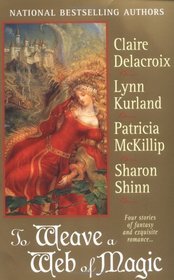
This is a decent collection, pleasing throughout but not excellent and likely not terribly memorable. Needless to say, I come at it from the fantasy end of the spectrum, and I suspect that fantasy readers will be more pleased by it than romance readers, for only one of the stories properly delivers the happily ever after ending that the romance genre demands. Still, as mind candy it works admirably well, and I spent a very enjoyable afternoon reading it.
I picked the anthology up for the first story, Patricia McKillip's "The Gorgon in the Cupboard." It is also the best in the book -- so good, in fact, that it was later included in the Science Fiction Book Club's anthology The Best Short Novels: 2005. It is a story about Harry, a struggling painter desperately in love with his mentor's beautiful wife, and Jo, a girl destitute and forsaken on the streets after several hard turns of fortune. The fantasy element comes into play when Harry pulls out a painting he never finished because his model disappeared and paints his mentor's wife's mouth onto it in a fit of despondency that he will never be able to create a work worthy of her; he is understandably shocked when the mouth comes to life and begins to speak to him. That is the only fantasy element obvious in the story (though it is a rather glaring one); the setting is vague and paintings speaking are clearly not a common occurrance. The romance is also very slight. This is because what the story is really about is perception, the ways that we see what we want rather than what is. It's gossamer-light, yet far richer than it seems on the surface, wise and sensitive to the myriad ways life is fragile and bittersweet, particularly for women. It is stop-me-dead-in-my-tracks (reading-wise) beautiful.
The second story, Lynn Kurland's "The Tale of Two Swords," is the one I suspect romance readers will be happiest with, and it made me smile and roll my eyes in equal amounts (often at the same time). It made me roll my eyes for more reasons than I can count -- the self-conscious modern fairy tale narration (complete with "In which [blank happens]" as the title of each chapter); the combination of hopelessly modern actions on the characters' part even as they speak in hopelessly archaic (and likely inaccurate) dialogue; the fact that the man has just lost his family and his kingdom in an epic battle, the woman has a price on her head, and all they do is frolic in the forest getting muddy. It also doesn't have time to even get to the two swords part of the title -- the story is entirely the romance component (and the true happily ever after ending). I believe the story is something of a prequel to one of Kurland's ongoing series, so perhaps the two swords part is dealt with in one of the novels. However, despite all those things that irked me, I still couldn't help liking the characters and liking their romance, so I suppose Kurland did her job well. (Should I hate myself a little for falling for it?)
The third story, Sharon Shinn's "Fallen Angel," is the one romance readers will have the most trouble with, and it may even be hard for fantasy readers that are unfamiliar with Shinn's Samaria series. It's set ten years after the end of Archangel (and even has a fairly toothless cameo by the Archangel Gabriel) and Shinn seems to assume that the reader has enough background knowledge of her books that she doesn't need to explain the slightly unusual way Samaria works. Unfortunately, this has led to some readers calling the story sacrilegous, because they have no context for this tale of angels behaving badly. For those who want to read the story and don't have that context, please keep in mind that the angels are nothing more than humans with wings -- they are not actually the angels of Christian mythology. Even more unfortunately, "Fallen Angel" just doesn't quite work as either fantasy or romance -- as I already mentioned, Shinn doesn't give enough grounding in the fantasy world-building to satisfy those fans, and the romance is decent (if of the "ooo, what a sexy bad boy" variety) only until the ending totally destroys suspension of disbelief with an out-of-left-field resolution that heaps all the evils in the world on one head. Still, I didn't hate the story, because it actually starts to address some of the thornier side of the world of Samaria -- the sort of chaos that can ensue when a ruling class with a free love worldview comes into conflict with a merchant class with very strict rules of propriety.
The fourth story, Claire Delacroix's "An Elegy for Melusine," is a retelling of the Melusine myth. It hews very closely to the story as described on Wikipedia (I wasn't overly familiar with the myth, so I looked it up, lol) and is rendered in serviceable enough prose that the myth's full power shines through. It has a totally unnecessary framing story, unfortunately, but other than that I quite liked it. However, romance readers should again be warned: the myth does not have a particularly happy ending.
I picked the anthology up for the first story, Patricia McKillip's "The Gorgon in the Cupboard." It is also the best in the book -- so good, in fact, that it was later included in the Science Fiction Book Club's anthology The Best Short Novels: 2005. It is a story about Harry, a struggling painter desperately in love with his mentor's beautiful wife, and Jo, a girl destitute and forsaken on the streets after several hard turns of fortune. The fantasy element comes into play when Harry pulls out a painting he never finished because his model disappeared and paints his mentor's wife's mouth onto it in a fit of despondency that he will never be able to create a work worthy of her; he is understandably shocked when the mouth comes to life and begins to speak to him. That is the only fantasy element obvious in the story (though it is a rather glaring one); the setting is vague and paintings speaking are clearly not a common occurrance. The romance is also very slight. This is because what the story is really about is perception, the ways that we see what we want rather than what is. It's gossamer-light, yet far richer than it seems on the surface, wise and sensitive to the myriad ways life is fragile and bittersweet, particularly for women. It is stop-me-dead-in-my-tracks (reading-wise) beautiful.
The second story, Lynn Kurland's "The Tale of Two Swords," is the one I suspect romance readers will be happiest with, and it made me smile and roll my eyes in equal amounts (often at the same time). It made me roll my eyes for more reasons than I can count -- the self-conscious modern fairy tale narration (complete with "In which [blank happens]" as the title of each chapter); the combination of hopelessly modern actions on the characters' part even as they speak in hopelessly archaic (and likely inaccurate) dialogue; the fact that the man has just lost his family and his kingdom in an epic battle, the woman has a price on her head, and all they do is frolic in the forest getting muddy. It also doesn't have time to even get to the two swords part of the title -- the story is entirely the romance component (and the true happily ever after ending). I believe the story is something of a prequel to one of Kurland's ongoing series, so perhaps the two swords part is dealt with in one of the novels. However, despite all those things that irked me, I still couldn't help liking the characters and liking their romance, so I suppose Kurland did her job well. (Should I hate myself a little for falling for it?)
The third story, Sharon Shinn's "Fallen Angel," is the one romance readers will have the most trouble with, and it may even be hard for fantasy readers that are unfamiliar with Shinn's Samaria series. It's set ten years after the end of Archangel (and even has a fairly toothless cameo by the Archangel Gabriel) and Shinn seems to assume that the reader has enough background knowledge of her books that she doesn't need to explain the slightly unusual way Samaria works. Unfortunately, this has led to some readers calling the story sacrilegous, because they have no context for this tale of angels behaving badly. For those who want to read the story and don't have that context, please keep in mind that the angels are nothing more than humans with wings -- they are not actually the angels of Christian mythology. Even more unfortunately, "Fallen Angel" just doesn't quite work as either fantasy or romance -- as I already mentioned, Shinn doesn't give enough grounding in the fantasy world-building to satisfy those fans, and the romance is decent (if of the "ooo, what a sexy bad boy" variety) only until the ending totally destroys suspension of disbelief with an out-of-left-field resolution that heaps all the evils in the world on one head. Still, I didn't hate the story, because it actually starts to address some of the thornier side of the world of Samaria -- the sort of chaos that can ensue when a ruling class with a free love worldview comes into conflict with a merchant class with very strict rules of propriety.
The fourth story, Claire Delacroix's "An Elegy for Melusine," is a retelling of the Melusine myth. It hews very closely to the story as described on Wikipedia (I wasn't overly familiar with the myth, so I looked it up, lol) and is rendered in serviceable enough prose that the myth's full power shines through. It has a totally unnecessary framing story, unfortunately, but other than that I quite liked it. However, romance readers should again be warned: the myth does not have a particularly happy ending.

Helpful Score: 1
I bought book primarily for the story by Lynn Kurland alone. I love Ms. Kurland's work and I wasnt disappointed with it.


