12 member(s) found this review helpful.
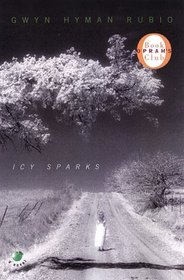
As a first novel about growing up poor, orphaned, and prone to fits in a small Appalachian town, Icy Sparks tells a fascinating story. By the time the epilogue rolls around, Icy has prevailed over her disorder and become a therapist: "Children silent as stone sing for me. Children who cannot speak create music for me." For readers familiar with this particular brand of coming-of-age novel--affliction fiction?--Icy's triumph should come as no great surprise. That's one problem. Another is Rubio's tendency to lapse into overheated prose: this is a novel in which the characters would sooner yell, pout, whine, moan, or sass a sentence than simply say it. But the real drawback to Icy Sparks is that some of the characters--especially the bad ones--are drawn with very broad strokes indeed, and the moral principles tend to be equally elementary: embrace your difference, none of us is alone, and so on. When Icy gets saved at a tent revival, even Jesus takes on the accents of a self-help guru: "You must love yourself!" With insights like these, this is one Southern novel that's more Wally Lamb than Harper Lee.

Mary B. (
eagles) wrote on 7/18/2007...
11 member(s) found this review helpful.
Ick. I agree with a previous reviewer about my disappointment at her religious awakening at the end of the book. I got the feeling she knew what she wanted to end with all along and tried to make it fit. The ending overshadowed what was a fair book, but at times too cute and contrived. Would not read again nor recommend.
8 member(s) found this review helpful.
This book was great until the last ten pages or so when the main character gets "saved" and all of her problems are solved because she accepts Jesus. It was a cheap ending to what was an otherwise an enjoyable book. The ending actually made me angry enough to throw the book in the trash which is something I would never usually do.
4 member(s) found this review helpful.
This book was a great look into the misunderstanding of metal illness in decades past. Icy Sparks, the main character in this story, is one of the unfortune people to have to endure criticism, punishment, ridicule and the other personal tortures of mental illness.
This book is an easy read and worth your time for at least the education that can be reaped from the paged of this story.

Julie M. (
juls0621) wrote on 8/10/2007...
3 member(s) found this review helpful.
This books is set in rural Kentucky in the 50's and is about a ten year old girl, Icy Sparks. She is an orphan who lives with her grandparents and has Toerette's Syndrome (spelling?) where one has the uncontrollable urge to curse aloud. Her childhood is filled with shame and humiliation...but Icy finds solace in Miss Emily, an obese woman who is also an outkast.
This is an unforgetable book overspilling with hope, the imperfections we all live with. I love books that are in the Southern female voice...this book will not disappoint!

Candy B. (
candieb) wrote on 1/13/2008...
2 member(s) found this review helpful.
A friend of mine mailed this to me because she liked it so much. I knew it was an Oprah book, but I went in figuring I'd give it a try. I found it ridiculous. Even the serious parts left me stifling a giggle. You ever watch Barney? You know, the purple dinosaur? It was like those kids... they were all over-acting. This book is over-written. It's too much, it's too "big"... I finished it and while I felt for the main character, I couldn't get over the over-writing. Not my style.
2 member(s) found this review helpful.
There's something different about Icy but no one including Icy knows what it is. A girl deals with a psychological disorder the only way she knows how, long before a diagnosis is even coined. I loved her courage and spirit and was sad the book ended so quickly.
2 member(s) found this review helpful.
Sweet story about a girl who just wanted to be happy and fit in, in a world that didn't quite understand her.
2 member(s) found this review helpful.
The diagnosis of Tourette's Syndrome isn't mentioned until the last pages of Rubio's sensitive portrayal of a young girl with the disease. Instead, Rubio lets Icy Sparks tell her own story of growing up during the 1950s in a small Kentucky town where her uncontrollable outbursts make her an object of fright and scorn. "The Saturday after my [10th] birthday, the eye blinking and poppings began.... I could feel little invisible rubber bands fastened to my eyelids, pulled tight through my brain and attached to the back of my head," says Icy, who thinks of herself as the "frog child from Icy Creek." Orphaned and cared for by her loving grandparents, Icy weathers the taunts of a mean schoolteacher and, later, a crush on a boy that ends in disappointment. But she also finds real friendship with the enormously fat Miss Emily, who offers kindness and camaraderie. Rubio captures Icy's feelings of isolation and brings poignancy and drama to Icy's childhood experiences, to her temporary confinement in a mental institution and to her reluctant introduction?thanks to Miss Emily and Icy's grandmother?to the Pentecostal church through which she discovers her singing talent. If Rubio sometimes loses track of Icy's voice, indulges in unconvincing magical realism and takes unearned poetic license with the speech of her Appalachian grandparents ("'Your skin was as cold as fresh springwater, slippery and strangely soothing to touch'"), her first novel is remarkable for its often funny portrayal of a child's fears, loves and struggles with an affliction she doesn't know isn't her fault.
1 member(s) found this review helpful.
From Publishers Weekly
The diagnosis of Tourette's Syndrome isn't mentioned until the last pages of Rubio's sensitive portrayal of a young girl with the disease. Instead, Rubio lets Icy Sparks tell her own story of growing up during the 1950s in a small Kentucky town where her uncontrollable outbursts make her an object of fright and scorn. "The Saturday after my [10th] birthday, the eye blinking and poppings began.... I could feel little invisible rubber bands fastened to my eyelids, pulled tight through my brain and attached to the back of my head," says Icy, who thinks of herself as the "frog child from Icy Creek." Orphaned and cared for by her loving grandparents, Icy weathers the taunts of a mean schoolteacher and, later, a crush on a boy that ends in disappointment. But she also finds real friendship with the enormously fat Miss Emily, who offers kindness and camaraderie. Rubio captures Icy's feelings of isolation and brings poignancy and drama to Icy's childhood experiences, to her temporary confinement in a mental institution and to her reluctant introduction?thanks to Miss Emily and Icy's grandmother?to the Pentecostal church through which she discovers her singing talent. If Rubio sometimes loses track of Icy's voice, indulges in unconvincing magical realism and takes unearned poetic license with the speech of her Appalachian grandparents ("'Your skin was as cold as fresh springwater, slippery and strangely soothing to touch'"), her first novel is remarkable for its often funny portrayal of a child's fears, loves and struggles with an affliction she doesn't know isn't her fault. Agent, Susan Golomb; editor, Jane von Mehren.
Copyright 1998 Reed Business Information, Inc. --This text refers to an out of print or unavailable edition of this title.