



Helpful Score: 1
A review from Amazon.com:
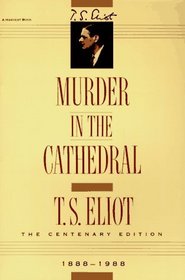
This 1935 play is a gem in English drama.
First, the tone, the style, the poetry are purely shakespearian. It gives the play a power it would otherwise never have. The biblical inspiration is not at all clear or direct. There are four tempters and temptations whereas Jesus only had three temptations and one tempter.
The play does not only recall the martyrdom of Thomas Becket. It shows he probably sinned, committed the sin of pride or vanity, though with the best intention : to establish the church as the supreme ruler. Yet this event is also the first fight between the English crown and the church, a fight that will culminate under Henry VIII with the creation of the Church of England.
The play is also a clear argumentation in favor of that extreme act for several reasons. One, sympathy for the underdog is not justice. Two, the killers were absolutely disinterested and were to be banished after the act. Three, this murder was necessary to strengthen the King's power, hence the country. Four, Thomas was a « monster of egotism » verging into mania and he committed « suicide while of unsound mind ».
But the play is a lot wider than that. It defends the simple people who suffer all the time. It defends those who possess some fraction of truth, for which it is worth dying if necessary. It advocates the most total and radical freedom of thought, freedom of speech and freedom to defend one's ideas to the bitter and bloody end that society will necessarily impose.
Finally it shows that England has three levels of power : the King, the barons and the church, and one level of constant fear and suffering, the people, the labourers. Here the church is curbed to the King's power. Later on the King's power will be curbed to the barons' power with John Landless, and that will be the beginning of parliamentary power, of democracy. Thomas Becket refuses to go that way, hence slowing down history by strengthening the King only and leading England into centuries of strife among barons and between two families to control the throne as the only source and center of power. Parliamentarism will only succeed fully in the seventeenth century. Thomas Becket's choice could have been different, from a political point of view that he refuses from the very start.
This 1935 play is a gem in English drama.
First, the tone, the style, the poetry are purely shakespearian. It gives the play a power it would otherwise never have. The biblical inspiration is not at all clear or direct. There are four tempters and temptations whereas Jesus only had three temptations and one tempter.
The play does not only recall the martyrdom of Thomas Becket. It shows he probably sinned, committed the sin of pride or vanity, though with the best intention : to establish the church as the supreme ruler. Yet this event is also the first fight between the English crown and the church, a fight that will culminate under Henry VIII with the creation of the Church of England.
The play is also a clear argumentation in favor of that extreme act for several reasons. One, sympathy for the underdog is not justice. Two, the killers were absolutely disinterested and were to be banished after the act. Three, this murder was necessary to strengthen the King's power, hence the country. Four, Thomas was a « monster of egotism » verging into mania and he committed « suicide while of unsound mind ».
But the play is a lot wider than that. It defends the simple people who suffer all the time. It defends those who possess some fraction of truth, for which it is worth dying if necessary. It advocates the most total and radical freedom of thought, freedom of speech and freedom to defend one's ideas to the bitter and bloody end that society will necessarily impose.
Finally it shows that England has three levels of power : the King, the barons and the church, and one level of constant fear and suffering, the people, the labourers. Here the church is curbed to the King's power. Later on the King's power will be curbed to the barons' power with John Landless, and that will be the beginning of parliamentary power, of democracy. Thomas Becket refuses to go that way, hence slowing down history by strengthening the King only and leading England into centuries of strife among barons and between two families to control the throne as the only source and center of power. Parliamentarism will only succeed fully in the seventeenth century. Thomas Becket's choice could have been different, from a political point of view that he refuses from the very start.
