Search - Into Thin Air: A Personal Account of the Mt. Everest Disaster

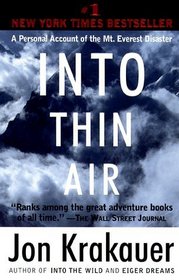
Into Thin Air: A Personal Account of the Mt. Everest Disaster
Larger
Into Thin Air: A Personal Account of the Mt. Everest Disaster
Author: Jon Krakauer

Book Information
Publisher: Anchor
Book Type: Paperback
Rating:

ISBN-13: 9780385492089 - ISBN-10: 0385492081
Pages: 416


Other Versions of this Book: Paperback, Audio CD, Audio Cassette, Audio Cassette, Hardcover, Hardcover

Book Description:
When Jon Krakauer reached the summit of Mt. Everest in the early afternoon of May 10,1996, he hadn't slept in fifty-seven hours and was reeling from the brain-altering effects of oxygen depletion. As he turned to begin the perilous descent from 29,028 feet (roughly the cruising altitude of an Airbus jetliner), twenty other climbers were still pushing doggedly to the top, unaware that the sky had begun to roil with clouds...

Into Thin Air is the definitive account of the deadliest season in the history of Everest by the acclaimed Outside journalist and author of the bestselling Into the Wild. Taking the reader step by step from Katmandu to the mountain's deadly pinnacle, Krakauer has his readers shaking on the edge of their seat. Beyond the terrors of this account, however, he also peers deeply into the myth of the world's tallest mountain. What is is about Everest that has compelled so many poeple--including himself--to throw caution to the wind, ignore the concerns of loved ones, and willingly subject themselves to such risk, hardship, and expense?

Written with emotional clarity and supported by his unimpeachable reporting, Krakauer's eyewitness account of what happened on the roof of the world is a singular achievement.

Members who requested this book also requested:

Similar books to this author and title:
Touching the Void: The True Story of One Man's Miraculous SurvivalThe Climb: Tragic Ambitions on EverestInto the Wild


Genres:

Top Member Book Reviews

Christina W. (CuriousChristina) wrote on 4/18/2008...

4 member(s) found this review helpful.

I picked this book up as a tonic for the hottest days of summer and found I had to put it aside several times as the story felt so immediate and personal. The desire to reach the fullness of the story was in direct opposition to a palpable sense of dread that grew with each chapterâ€"the writing is that good.

Liese S. (bookaddict) wrote on 5/29/2007...

3 member(s) found this review helpful.

A fairly gripping nonfiction account of tragic events during the author's ascent (with a group) up Everest. I enjoyed this, although I found it a bit self-indulgent, and the author has admitted since that he probably wrote it too soon after the event--he said he got some details wrong, and his story was affected/distorted by the emotional aftermath. But definitely worth the read. I liked Krakauer's Under the Banner of Heaven and Into the Wild as well.

Other books about climbing that I recommend more strongly than this one are "K2: A Woman's Place is on Top" and "Touching the Void". For other nonfiction books on extreme sports: "To the Edge" is a phenomenal book about ultramarathoning and "Winterdance" is a terrific account of the Iditarod sled race, and "Shadow Divers" is just a wonderful book about deep wreck diving.

Diana N. (dancingnomad3) wrote on 9/6/2008...

1 member(s) found this review helpful.

Into Thin Air is "a personal account of the Mt. Everest disaster" by Jon Krakauer (author of Into The Wild.) When I first saw the title and subtitle, I figured the climbers get blown off the mountain by a storm. Actually, it's about the challenges of climbing at high altitudes where the air is considerably thinner. About two-thirds of the book details the climb up Everest before the disaster. Even in best of conditions, it sounded like a pretty harrowing ordeal.

Standing roughly 29,000 feet, Everest is the tallest mountain on Earth. Climbing it requires extraordinary skill, strength, and physiology. Many people have died climbing it. The higher you go up a mountain, the more climbers are prone to various forms of altitude sickness. Even if you do not get altitude sickness, with less oxygen to your brain, a person's mental and phsyical capacity is reduced accordingly, making one susceptable to poor judgment, cold, and injuries.

Acclimatization is an important process while climbing at high altitudes. While ascenting, climbers should rest periodically to get used to the thinning air. In the case of Everest, there are four camps above the Base Camp (17,600 ft). The acclimatization process on Everest consists of multiple climbs to each of those camps and back, each time ascending to the higher camp. Even then, staying an extended period of time above a certain height without oxygen will kill your brain cells. When making the actual summit attempt, perhaps couple of nights are spent at the lower camps while only one night is spent at the higher camps. On summit day, a climber will typically leave Camp Four just past midnight, with hopes of making it to summit by 1 or 2 pm at latest, giving them enough time for the decent back to camp before dark. That's a very long day of climbing - 15 hours or more - under the most difficult of conditions. Perhaps even after some sleepless nights in the camps below.

Imagine the challenges of climbing Everest, and then add to that a hurricane like blizzard. Some of the climbers get stuck in it on their descent from the summit. Some make it, some don't. From the very beginning, Krakauer does a great job of describing the various climbers who get involved in the disaster. It was interesting to read about the individuals' background, differences, and their performance on the mountain. In the end, it was not necessarily the strongest who survive. Sometimes luck or fate play a roll. Most times though, it's human factor. A simple mistake can lead to huge disasters, or a heroic deed saves lives.

Perhaps the one character who surprised me the most is of one who was left for dead - twice! This person was presumed dead and left overnight in a storm with no shelter in sub-freezing temperatures. Somehow the next day he regained enough strength and lucidity to find his way back to Camp Four. After other climbers helped him get comfortable, they yet again figured he would die and left him unattended during another stormy night where he suffered some more. Despite serious injuries from frostbite, he survived.


Climbing Everest crossed my mind only once several years ago when a friend told me about his desire to climb to the Everest Base Camp. By the sound of it, the Base Camp is fairly attainable (as long as you can cough up the expensive fees) so I thought... hmm. Few seconds later though, I figured I'd probably die and hadn't given it a second thought since. However, next time I'm in the mountains snowboarding and feeling cold, or struggling up some difficult hike, I hope I will remember the adversity faced by the climbers described in the book and gain strength from it.

.

Matt B. (BuffaloSavage) wrote on 6/24/2008...

1 member(s) found this review helpful.

This book is worth reading as an example of the best journalistic prose that we can get these days. Readable for those into travel and adventure books; interesting about the psychology of risk takers; inspiring tale of survival; cautionary story of guilt and recrimination and damage to reputation.

W. R. (NYbooks) wrote on 4/10/2008...

1 member(s) found this review helpful.

Biography * * * * Harrowing account of group of climbers who scaled Mt. Everest. Unforgettable.

Rebecca M. wrote on 10/11/2007...

1 member(s) found this review helpful.

Exciting and a quick read. Interesting even for a non-climber.

Amy R. wrote on 2/3/2007...

1 member(s) found this review helpful.

Non-fiction about a failed trip to the summit of Mount Everest. It was hard to put down. The author does a good job of balancing history of Everest with the stories of the people who lived and died on the mountain. Great book!

MaryAnn R. (MaryAnn) wrote on 1/27/2006...

1 member(s) found this review helpful.

This is an amazing story about groups of mountain climbers trying to reach the summit of Mt. Everest. I learned details about high-altitude climbing that I never knew before.


Please Rate these Book Reviews

Nancy H. wrote on 7/29/2009...


I had wanted to read this book from the time I read an excerpt in Reader's Digest. At that time, the book was, of course, only in hardback, something I rarely purchase. By the time it was issued in paperback, I had forgotten all about it. When I joined Paperback Swap and began searching for books, it returned to my memory, and I'm glad it did.

While reading it, I was constantly checking for Google images of the various locations on Everest to get a sense of the difficulty of each portion of the climb. I also read other accounts on the internet of the tragedy of May 1996, including a multi-piece feature from Outside magazine done on the tenth anniversary. With all that, I feel that this is a very accurate accounting of the events that unfolded. I was disturbed to read toward the end of the book a scathing letter sent to Krakauer from Fischer's sister, in which she stated, "You have commented on what SHOULD have been done by the leaders, the Sherpas, the clients, and have made arrogant accusations of their wrongdoing. All according to Jon Krakauer, who after sensing the doom brewing, scrambled back to his tent for his own safety and survival..." She later says, "There are no answers. No one is at fault. No one is to blame." Really? Sounds like you're placing at least some of the blame squarely on Krakauer's shoulders, who was too wiped out physically to have been of help to anyone and probably would have died himself if he had tried. Letting out her anger was a good idea, but not at the expense of Krakauer's emotions after the fact.

I don't believe that Krakauer was making "arrogant accusations"; I believe he was simply reporting the event and trying to be as factual as possible. By his own admission, the large article he had written for Outside magazine shortly after those terrible events contained some inaccuracies, and the book was written partly to correct those inaccuracies. (The most serious mistake occurred because he had not received return phone calls from one trekker prior to writing the article, and at the time the incident occurred, he was confused due to hypoxia and fatigue, fairly common at that altitude.)

The tragic events of May 1996 occurred not because of any one big error on anyone's part, but rather due to a series of errors. I believe that Into Thin Air reports those errors without admonishment, leaving the reader to form his/her own opinion as to why so many died. However, I disagree with one of Krakauer's statements: that trying to learn from the mistakes is "for the most part an exercise in denial and self-deception." There is a lot to be learned from this incident. It is obvious, though, that with the continued commercialization of climbing Everest and the other "seven summits," with little regard for the experience and ability of those willing to pony up the fees, it hasn't happened.

Melita G. (Melita) wrote on 6/1/2009...


This book gave a good first hand account of the events on Everest in 1996 when there were so many deaths including those of two prominent Everest guides. But you MUST read the account of the Russin guide Anatoli Boukreev in his book "The Climb". He is the true hero of this disaster.

Caitlin M. kraaivrouw - San Leandro wrote on 5/23/2009...


This is a book I have a pattern with: purchase, read, giveaway, rinse, repeat. I think this is the fourth or fifth copy I've had & the fourth or fifth time I've read it. I love this book. Krakauer's a great writer & the story is tragic on a grand scale.

I have very clear memories of when these awful events happened. I was working a graphic design job in a warehouse that looked out over a parking lot by Lake Union in Seattle. I had a little radio & would listen to NPR all day & that's where I heard the coverage of the people lost on the mountain & the attempts to rescue them & then the death toll. I remember it raining a lot during that time, but it was Seattle so it rained a lot all of the time. A friend of mine had a rock climbing housemate who knew Scott Fischer, one of the guides who died. The whole thing was heartbreaking & seemed so unnecessary.

Jon Krakauer was on Everest with Rob Hall's group as a journalist for Outside Magazine - to summit Everest & to write about the relatively new practice of commercial guided climbs on Everest. Like all of his books, Krakauer includes a fair amount of history - of mountain climbing, adventuring, & of Everest. He was one of the few people from the group that climbed that day that walked away alive & this book is definitely a survivor's meditation. There is a fair amount of controversy surrounding all of this - who did what when, who should've done what but didn't, who wanted to save his own ass more, who should never have been on the mountain. At the end of the day, though, I love this book - a tragedy that happens inch-by-inch as one decision after another adds up to disaster.

Connie L. wrote on 8/11/2008...


One of the best books I've ever read - exciting and thought-provoking, and extremely well-written.

Ellie (EllieW) - Garland, TX wrote on 9/24/2007...


I couldn't put this book down. Excellent read!

Christina P. wrote on 5/13/2007...


Amazing tale of survival and death in the wilderness by one of the greatest journalists around.

Melissa M. (sassenach) wrote on 5/7/2007...


Wonderful account a disasterous climb of Everest.

Pete F. (Pedro) wrote on 4/22/2007...


An absolutely unforgettable account of a ascent on Mount Everest that ended in disaster. You will remember this story until the day you die.

Stacy H. wrote on 4/20/2007...


I love this amazing story. I recieved it as a gift, took a chance and loved it - it made me want to learn more about Mt. Everest and so much of the world I had never thought of before. I can not rave enough about this true adventure of incredible ability of human beings.

Leigh R. (iwannaread) wrote on 4/19/2007...


This was an interesting account of Everest 1996, although from my own personal observation, I found The Climb by Anatoli Boukreev to have a more "factual" feel to it. This book is well written and a good read, but it leaves one wondering how much the authors emotions clouded his interpretation of those days. This review is in no way intended to be judgemental as I can't even imagine what any of the climbers endured.


Book Wiki
Series
Original Publication Date (YYYY-MM-DD)
People/Characters
Real Places
Fictional Places
Important Events
Awards and Honors